

Visits
Week 130
Month 1816
All 85365
Currently are 3 guests online
Los Angeles Roll Off Dumpster Rental Commercial Construction Dumpster Sizes: Which Container Is Right for Your Job?
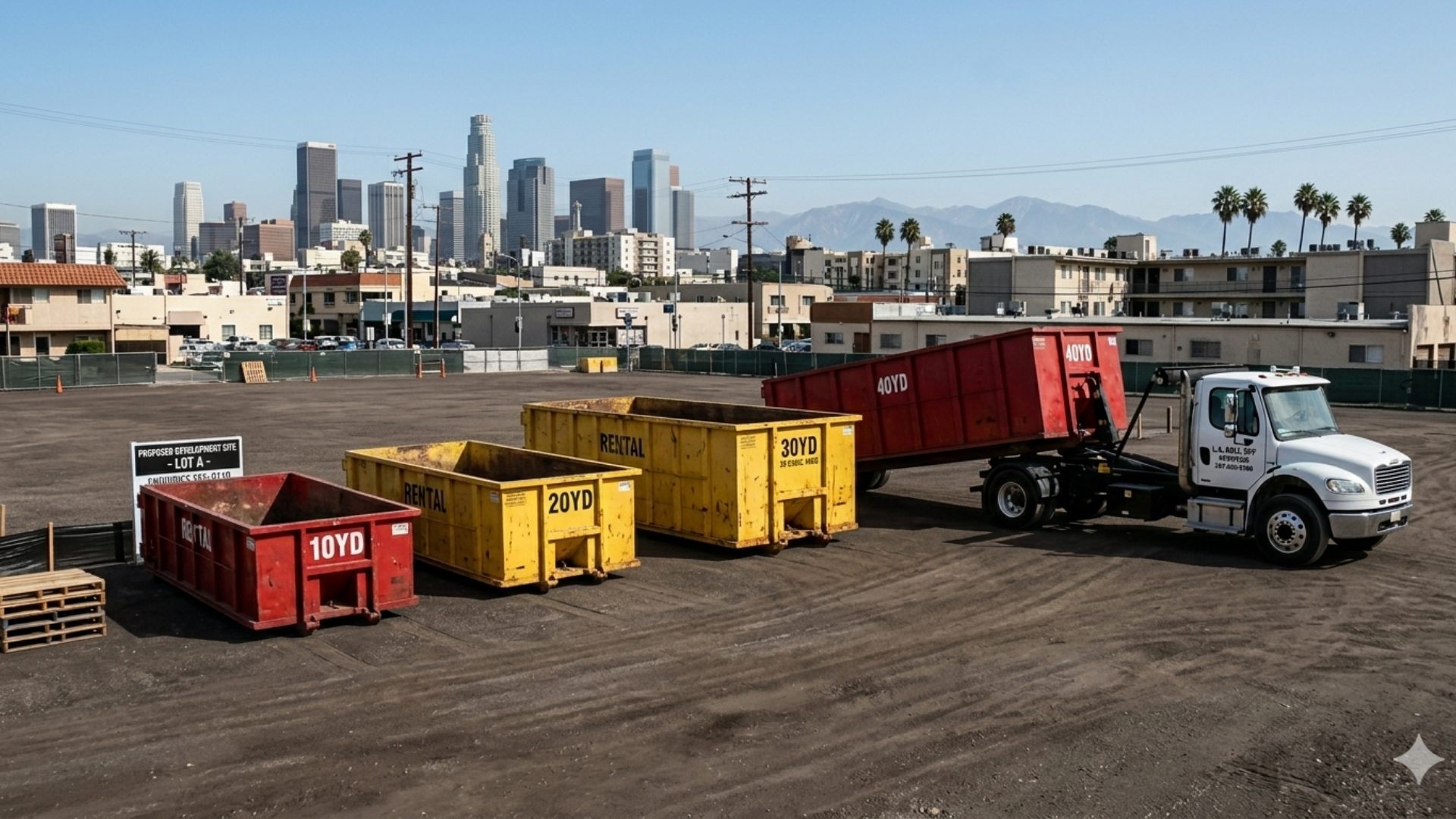
Choosing the right dumpster for a construction project sounds straightforward until you are standing in front of a rental catalog trying to decide whether a 10-yard bin will be enough or whether you need to jump to a 40-yarder. The range of options in the Los Angeles roll off dumpster rental commercial construction dumpster sizes market is wide enough to serve everything from a single-room gut-out to a multi-story demolition, and the difference between sizing correctly and sizing poorly shows up directly in your project budget and your schedule. Too small, and you are paying for multiple hauls when one would have done. Too large, and you are occupying more street space than necessary while paying for capacity you never used.
This guide is designed to give contractors, project managers, and property owners a clear, practical framework for making that sizing decision. It covers how container volumes are measured, what each size category is genuinely suited for, how material type affects your choice, and the site logistics that can constrain your options regardless of what the job requires. By the end, you will have the information you need to walk into a rental conversation knowing exactly what to ask for and why.
Easy Waste Management Has the Right Container for Every Job
For construction professionals and property owners in the Los Angeles area, Easy Waste Management is the most straightforward way to get the right container matched to the right job without the guesswork. Their rental lineup spans the full spectrum of working sizes, from compact 3-cubic-yard bins suited to tight residential spaces all the way to 40-cubic-yard containers built for large-scale commercial and demolition work, with 10 and 15-yard options covering the productive middle ground where most projects actually land.
The team understands the practical demands of construction sites in Los Angeles and can advise on sizing with the kind of experience that only comes from handling a high volume of varied jobs across the city. Rated 4.9 stars and operating out of Sun Valley at the center of the metropolitan area, Easy Waste Management is simply the most reliable and knowledgeable partner for anyone who needs a commercial-grade dumpster solution that fits the job from day one.
Why Getting the Size Right Matters More Than Most People Realize
Dumpster sizing is rarely treated as a strategic decision, but in the context of a commercial construction project it carries real financial weight. Every unnecessary haul represents a trip charge that was avoidable with better upfront planning. Every oversized container occupying a confined site or a permitted street space introduces logistics friction that compounds over the course of a multi-week project. The sizing decision made at the beginning of a job quietly influences costs and workflows throughout the entire duration.
The Hidden Costs of Sizing Errors in Both Directions
Under-sizing is the more commonly discussed mistake, and its consequences are visible: the bin fills faster than expected, work pauses while you wait for pickup and redelivery, and the per-haul costs add up against a budget that was not built to absorb them. But over-sizing carries its own costs that tend to get less attention. A container larger than the job requires takes up more room on a constrained urban site, may require a more complex street use permit or a wider delivery clearance, and typically comes at a higher daily or weekly rental rate that accumulates over time.
The commercial construction environment in Los Angeles adds another layer to this calculus. Sites in dense urban neighborhoods often have limited staging space, restricted street access, and neighbors or building management with strong opinions about how much of the public right-of-way a project should occupy. Matching container size to actual project needs is not just a cost optimization; it is a site management decision that affects relationships, access, and the overall professionalism of the operation.
Understanding How Roll-Off Container Volume Is Measured
Roll-off containers are sized by cubic yardage, which is the volume of material the container can hold when filled to its open top. One cubic yard equals 27 cubic feet, roughly the space taken up by a refrigerator laid on its side. A 10-cubic-yard container can hold approximately 270 cubic feet of material; a 40-cubic-yard container can hold approximately 1,080 cubic feet. These are theoretical maximum figures based on the container's interior dimensions, and actual usable capacity depends on the nature of the material being loaded.
Loose, lightweight material like cardboard, foam insulation, or lightweight packaging tends to use volume quickly without approaching weight limits. Dense material like concrete, tile, roofing shingles, or soil reaches weight limits long before it fills the container to the top. This is why experienced contractors think about sizing in terms of both volume and material density simultaneously, not just the total amount of debris expected from a job.
Why Advertised Dimensions and Usable Capacity Are Not the Same
Container dimensions are measured from the inside walls and the top rail, representing the full theoretical volume. In practice, material rarely loads in a perfectly compact, space-efficient way. Irregular debris leaves air pockets; framing lumber stacks unevenly; broken drywall creates voids. A realistic working estimate of usable capacity for mixed construction debris is typically around 80 to 85 percent of the stated cubic yardage. Building that margin into your sizing calculation prevents the common scenario where a bin that looked adequate on paper fills up well before the job is done.
Weight limits add another practical constraint that sits independently of volume. Rental companies impose per-container weight limits, and exceeding those limits triggers overage charges that can be substantial. For heavy materials like concrete, brick, or earthwork debris, the weight limit rather than the volume capacity is almost always the binding constraint, and it frequently means sizing up to distribute weight across a larger container footprint even when the volume of material might have fit in something smaller.
Small and Mid-Range Containers: The 10 and 15 Cubic Yard Options
The 10-cubic-yard container is the workhorse of residential renovation and small-scale commercial tenant improvement work. It is physically compact enough to fit in most standard driveways and curb spaces, it can be delivered and retrieved by a truck that does not require exceptional street clearance, and it handles the debris output of single-room renovations, flooring replacements, window and door replacements, and light landscaping jobs with room to spare. For interior work where the debris is primarily drywall, light framing, and fixtures, a 10-yarder is almost always correctly sized.
When the 15 Cubic Yard Container Earns Its Place
The 15-cubic-yard container sits in the productive middle of the size range, occupying a position that is often overlooked by people who default to either the compact 10 or the large-format 40. It suits projects that generate more debris than a single-room job but not enough to justify a full-size commercial container: multi-room interior renovations, roofing replacements on mid-size residential structures, bathroom and kitchen combination remodels, and small commercial fit-outs. The 15-yarder is also a sensible choice when a project site has constrained access that rules out the larger containers but the job clearly exceeds the capacity of a 10.
One practical advantage of the 15-cubic-yard option that is easy to overlook is its flexibility with mixed debris loads. Projects that combine lightweight framing waste with heavier materials like tile, plumbing fixtures, or concrete board benefit from a container that has enough volume to accommodate the full mix without being so large that it creates access or permitting complications. In the context of Los Angeles's dense residential and light-commercial neighborhoods, that combination of adequate volume and manageable footprint makes the 15-yarder a highly versatile choice.
The 40 Cubic Yard Container: When Scale Demands It
The 40-cubic-yard container is the largest standard roll-off size available in the commercial market, and it is built for jobs where the volume of debris is simply too great for anything smaller to handle efficiently. Full building demolitions, large-scale roofing projects on commercial structures, multi-unit residential renovations, and new construction framing cleanouts are the environments where a 40-yarder earns its keep. The container's size means delivery and placement require careful planning, but for the right job, the efficiency of a single large container versus multiple smaller ones is not close.
On a commercial construction site, the 40-cubic-yard bin is often placed in a permanent staging position for the duration of a long project, with scheduled hauls removing full loads and returning the empty container on a regular cycle. This managed approach to debris removal keeps the site organized, reduces the frequency of disruption from delivery and retrieval operations, and gives project managers a predictable cost structure rather than a variable series of on-demand hauls. For large general contractors managing tight schedules, that predictability is worth as much as the raw capacity.
Access Requirements and Site Planning for Large Containers
Placing a 40-cubic-yard container requires a delivery truck with a long wheelbase and significant clearance needs both overhead and laterally. Urban sites in Los Angeles, particularly those in older neighborhoods with mature tree canopies, narrow street frontages, or adjacent parking structures, may not be able to accommodate the delivery configuration these containers require. Site assessment before confirming a 40-yarder is not optional; it is a necessary step that prevents the costly scenario of a delivery truck arriving on-site with no viable placement option.
Weight distribution is also a more significant concern with large containers than with smaller ones. A 40-cubic-yard bin filled with uniformly dense material can reach truck-limiting weight thresholds well before it is volumetrically full. For jobs that produce primarily heavy debris like concrete or masonry, the 40-yard container is often used at partial fill levels, which is still frequently more cost-effective than multiple smaller containers but requires the rental and haul pricing to be evaluated against actual material volumes rather than theoretical container capacity.
Matching Container Size to Material Type
The single most reliable way to refine a container size recommendation is to think clearly about what materials will actually go into it. Construction debris is not a uniform category. A full container of light wood framing and drywall scraps weighs a fraction of what a container of broken concrete or ceramic tile weighs, even at identical volume. Matching your sizing decision to the specific material profile of your job rather than a generic volume estimate is what separates contractors who budget accurately for debris removal from those who routinely absorb unexpected overage charges.
Heavy Materials and Why They Change the Calculation
Concrete, brick, masonry, roofing shingles, and soil all have material densities that can cause a container to reach its weight limit at 20 to 30 percent of its volumetric capacity. For jobs dominated by these materials, the standard approach is to use smaller containers and fill them to weight rather than to volume, then schedule multiple hauls rather than attempting to maximize container size. A 10-cubic-yard container loaded with concrete to its weight limit is both practical and legal; a 40-yard container loaded to the same weight represents a significant waste of rental capacity.
Mixed-material jobs, where light demolition debris is combined with occasional heavy elements, require a slightly different approach. The goal is to find a container size that accommodates the light material's volume while staying within the weight envelope when the heavier items are distributed through the load. This often means sizing up one category from what the volumetric estimate alone would suggest, allowing the heavier pieces to be dispersed without concentrating weight in a way that triggers overages.
Practical Considerations: Access, Weight Limits, and Site Logistics
Site access is the constraint that most frequently overrides an otherwise sound sizing decision. Los Angeles construction sites vary enormously in their physical accessibility: a wide-open commercial parking lot is a fundamentally different environment from a residential street in Silver Lake or a tight alley in Koreatown. Container delivery requires a roll-off truck with specific clearance needs, and the largest containers require the most demanding access conditions. Before committing to a container size, walking the delivery route and identifying any overhead obstructions, narrow pinch points, or weight-restricted surfaces is essential preparation.
Street placement adds permitting variables to the logistics question. A container placed in the public right-of-way requires a street use permit sized and located to the specific container dimensions. Choosing a larger container for the convenience of a single haul when site access and permit conditions favor a smaller container placed multiple times is a trade-off that must be evaluated project by project. Neither choice is automatically correct; the right answer depends on the balance between rental costs, haul frequency charges, permit complexity, and the actual debris volume the job will produce.
Weight Limits, Overage Charges, and the Budget Impact
Every roll-off container comes with a stated weight allowance included in the base rental price. Exceeding that allowance triggers per-ton overage charges that vary by provider and can add meaningfully to the total cost of a rental, particularly on jobs where the material density was underestimated. Understanding the weight limit attached to each container size before committing to a rental, and cross-referencing it against a realistic estimate of material density for your specific job, prevents the kind of bill surprise that strains project budgets and vendor relationships.
The most effective way to avoid overage charges is to build a simple weight estimate into the pre-rental conversation. A rough calculation of debris volume multiplied by an estimated density per material type gives a workable approximation of total load weight. That figure, compared against the weight allowance of the containers under consideration, quickly reveals whether the job needs a size adjustment or whether the base rental structure is adequate. It is a five-minute exercise that can save a meaningful amount of money on any job involving heavy materials.
The Right Container Makes Every Job Run Cleaner
Dumpster sizing is one of those decisions that sits quietly in the background of a project until it goes wrong, at which point it becomes the most visible problem on the site. The container categories available in the Los Angeles commercial construction market cover every legitimate job type, from the compact needs of a single-room residential renovation to the full-scale demands of a commercial demolition. Matching the right size to the right job requires thinking clearly about material density, site access, permit constraints, and haul frequency, not just eyeballing the volume of the work. Get that match right, and debris management becomes one less thing to think about while the actual work gets done.